
Lets be quite clear about one thing, all religions practice idol worship in one form or another. This can take the form of an object, book, building or an element. They may deny it but if you look closely at their practices they all do it.
Hindu’s do not deny or hide the fact that they pray in front of idols. However, when people say we are idol worshippers, they either do not understand the concept or they are trying to be rude.
Remember this – Hindus do not have to be facing an idol to do prayers. They can pray at any time, any place and facing any direction they choose. However, the great Rishi’s and Sage’s realised that for ordinary people having an idol to focus on while praying would help them in their effort to connect to God.
The concept behind idol worship – The Bigger Picture
Answered by : Swami Tejomayananda (Date unknown)
Upasana means worship or literally sitting near. Upa means near and asana means sitting. Now sitting near is not meant only in the physical sense. So guru upasana, does not mean that I must sit next to the guru. It means that we must sit mentally near the object of our worship, and when we do this, we slowly begin to imbibe the qualities of that object.
The best example is a log of wood when it is placed near a fire. The log gradually becomes heated up and catches fire. For the log of wood this would be called agni upasana (sitting near the fire). Similarly, if I am cold and sit near a fire, I will also feel the heat of the fire and become warm.
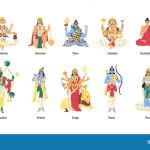
In the Vedas, it is said that we must do isht devata upasana (worship of our chosen deity). We have Rama, Krishna and Shiva as idols for worship. In truth, these are not mere idols, but ideals. As Swami Chinmayananda says, every idol represents an ideal.
People, unnecessarily criticise idol worship because they do not understand its significance. But in one form or another, everyone practices idol worship.
What are we doing when we salute the national flag? Though we see only a piece of cloth, we are really saluting or revering the ideal which the flag represents – our national aspirations, values and entire culture. Because the flag symbolises something greater than a piece of cloth, people protesting against a particular nation burn the flag of that country.
The use of symbol for worship is meant for making our minds single-pointed, whereby we gain the very same qualities of the ideal we revere. This is like tuning our television to a particular channel; we receive whatever programme is being broadcast by that station. A devotee meditating on Sri Ramachandra, who was the model of a perfect king, son, husband and brother, will slowly gain those same qualities as Sri Rama.
Similarly, we become exactly like the company we keep, even though at the beginning we may know that the qualities of our company are bad . For instance, a person who was not a smoker before he started living with people who smoked all the time, and they said, “Why do you not smoke also?” So he thought, “Why not try it just once?” and after that he became a regular smoker! When we live in the company of people we slowly imbibe their qualities and tendencies.
In the upasana section of the Vedas, wonderful meditations are prescribed in which we are given a symbol representing a greater ideal, upon which to fix the mind. By gathering all our attention at one point, we gain all the virtues of that ideal and finally become one with it.